The dictionary says what I did, and plan to do, is bad but I feel liberated

For 41 years I have resisted writing in books, even text books.   I have used post-it-notes, sheets of paper and a few other things but before now I have never defaced a book.

Times are changing.  That’s what the Diocesan School for Ministry does for you.

de·face  (d-fs)

tr.v. de·facedde·fac·ingde·fac·es

1. To mar or spoil the appearance or surface of; disfigure.
2. To impair the usefulness, value, or influence of.
3. Obsolete To obliterate; destroy.

[Middle English defacen, from Old French desfacier : des-de- + faceface; see face.]

de·facea·ble adj.
de·facement n.
de·facer n.

Through Thick and Thin

This autobiography is a joy to read, it kept my interest throughout and the last few pages delivered a strong ending.
Kowkhyn Wan, better known as Gok Wan or as Auntie Gok to his TV audience and Bebe to his family is a British TV style and fashion presenter famous for series such as How To Look Good Naked and Gok’s Fashion Fix.  I knew of Gok but actually knew his older brother, Kwok-Lyn, and older sister, Oilen.   We all lived on the same housing estate, Beaumont Leys, in Leicester and all went to the same schools – Barley Croft and Babington Community College.  This of course made it personally a good read as he described his life and school experiences in a place that I know so well.  There is a photo in the book of the family on a playground at the back of the estate.  Recognizing that particular wall of bricks bought back many of my own memories.
The book has so much more to it though for a wider readership.  Gok came from a Chinese/English mixed family, was overweight and gay.  He went on to develop anorexia, a disease that he has, and will continue to battle all of his life.  He is extremely candid about his life challenges.  Examples of this include when he describes the times when he had to give up his life and current education/career in London and return home to Leicester.
At times he glosses over some of his rougher edges, but who can blame him for that?  Despite these omissions what comes across is a guy who has shot into national stardom but never lost his true roots, the importance of family, hard work and helping others.
I’ve always been proud to come from Beaumont Leys, for attending Babington Community College.
And I’m proud of Gok for all that he has achieved.  If I take anything away from the book it is his bravery in allowing, and then writing about, all of his life experiences to shape who he is today.  How many of us would bare all of our dark secrets in public in order to give strength, courage and hope to others?

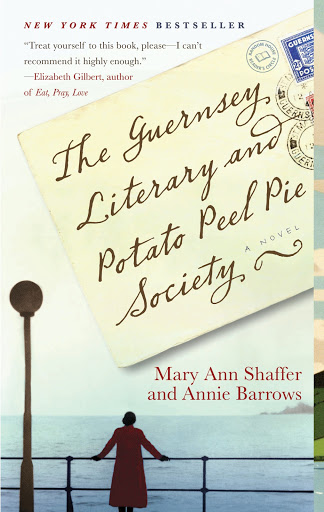
The Guernsey Literacy and Potato Peel Pie Society

Before I even start – this book was hard to put down from the first page onwards.  By the time that I got to the final fifty pages I knew I could not stop reading until I got to the end.
I have always loved the Channel Island of Guernsey.  I spent many happy Boys’ Brigade camps there growing up and a wonderful summer working in a hotel.  Did I mention the summer romance?  Guernsey was, and possibly still is, my ultimate place to feel safe.  If I ever ran away you would probably find me here.I’ve always been fascinated by how resilient the Channel Islander’s were during the German occupation.  The Guernsey Literacy and Potato Peel Pie Society captures a real sense of being there in the moment in a powerful but gentle way.  Character’s are developed naturally, the story unfolds like a petal on flower opening up as the sun rises and calls to a new day.  I was left longing for a period when thoughts were expressed in letters and we actually communicated our feelings in whole sentences with the benefit of elapsed time between each response.

The society provided a bond that no invading army could break.  A society that looked after each other when the world was dark and bleak.  A society that dared to be different without being different at all.

As Juliet discovered the charms of all that Guernsey had to offer, as she visited places that I had forgotten  that I loved many years ago.  I fell in love again with the people, the places and the peace of the island.

Shaffer and Barrows skillfully show that you don’t need violence or high drama to hold the reader close.  What you do need is relationships and community or in the books case a Literacy and Potato Peel Pie Society.

http://www.amazon.com/Guernsey-Literary-Potato-Peel-Society/dp/0385341008

The middle of nowhere

I’m still working out what this blog is and where it is going.  I think that sometimes I might write a whole stream of thoughts.  At other times it may just be a few sentences.  We will have to see how it goes.
Last week I was away with work, deep in the middle of America’s heartland.  As I sat on the plane I snapped the photo above and on one of the nights we stayed in the hotel pictured below.  In both places I thought “this is the middle of nowhere”.  It is easy to have thoughts like this when you live in a city but the more I reflected on on my own thoughts the more uncomfortable I became.
At the very heart of my faith is a passion for outward signs of our ministry in the world.  Actually to be more specific outward actions that come out of Christ’s love in the world.  Living out that passion requires that I constantly take a step back and look afresh at each and every situation, no matter how uncomfortable the view may be.  With that in mind my thoughts spun on their heels.
This is not the middle of nowhere – this is the center of somewhere.  Even when we see very little, or even nothing, we must be aware of everything.
In a week, where many of us celebrated the repealing of DOMA and the SCOTUS ruling on Prop 8, we may not see the room for compassion and understanding in those people who were hurt by these two landmark human right cases.  But we must.  We must find ways to stand together in Christ.  If we don’t then we risk the chance of replacing one person who feels as if they are in the middle of nowhere with another person who has exactly the same feelings.
We may not, and we should not, aim to make every place on earth like a city.  But we should aim to make every place on earth feel like a loving home, a home where all God’s children are welcome.

When You Are Engulfed In Flames

by David Sedaris

I have this habit with books, once I start one I am determined to finish it. A book that takes me two days to read is very good (in my opinion) a book that takes longer……. I started to read David Sedaris’s book about nine months ago.

I appreciate books that are mini essays. I really like books that describe real life and are sharp in their observations, plus if they are witty then all the better. This book has it’s moments, some characters are very well developed, occasionally the last sentence of a chapter reveals a thought or an alternative perspective. For me though, the book lacked direction. All the way up to the last few pages I was hoping for a final twist that would tie everything together, but it never came.

The final chapter did have one gem of a line “If God knows that I don’t believe in him, why would he go out of his way to help me?” – I’ll come back to that one.


So here we go


The old blog has been archived and so here is the chance to start with a clean slate.  

After an almost twenty year journey the Bishop of San Diego, last week, made me a Postulant for Holy Orders in the episcopal diocese of San Diego.   For the next three plus years I will enter a period of structured formation centered around the new diocesan School for Ministry.  I strongly feel that I have a call to the Bivocational Priesthood.   What is the bivocational priesthood?  That is a question that I have discerned greatly over the past year and will continue to discern in the future.  But for the purpose of this introduction it means that I feel called to continue to be employed in my secular job both whilst training and ultimately exercising a ministry as a priest.

What do I aim to achieve with this blog?  I want to record my thoughts and reflections as I move through this season of formation.  Write about some of the books that I am reading, both secular and as part of my training.  I’m sure other things will come to mind as time goes by.

About 15 years about I really was into the Star Trek franchise Voyager.   It comes to mind now.  Voyager had a history before the TV series started, but as viewers, we joined it as it was flung to the other side of the galaxy and we followed it as it journeyed home.  On its way it encountered strange new worlds, new life-forms, battled with enemies old and new, and it was a trailblazer with its first female captain.

My journey to ordination to the priesthood feels a little like that.  A journey home.


The Three Georges

A sermon preached at the Festal Evensong of St. George at St. Paul’s Cathedral
on April 28th 2013
Readings for Easter 5 / Year 1 / Daily Office
Psalm 8, Wisdom 7:22-8:1, Matt. 7:7-14 

Today we remEngland-St Georgeember the story of St. George.  The battle with the dragon, saving the princess and living happily ever after.   Stories throughout history have been used as a teaching tool, we know that Christ used the parable stories to teac
h complex principles and there is nothing wrong with this traditional story of St. George.  In it we are introduced to good and evil as well as the need to protect the defenseless and innocent.  I remember sitting on my classroom floor the age of six, drinking my daily milk, listening to my teacher, Miss Woolly, read this story.   I may not quite have grasped the need to protect the defenseless but I did understand good from bad, right from wrong.  The story planted the seed and as a child it made me ask questions, and by asking I began to learn.

Let’s take a look at another version of the story.  This story is widely accepted as the realistic account of St. George.  Take yourself back to the third century and we find George being born somewhere in the Mediterranean region.  His mother was from Palestine and he spoke Greek.  He was also a Christian.  He followed his father into the Roman army and became a respected soldier.   His life came to an end when he became a martyr when he was beheaded for refusing to persecute Christians from foreign lands.

This story is more complex and if we are to get the full effect of it we need to seek out what the story can teach us, especially about our life today.   I’d like to suggest to you that this version of the story shows us that Saint George is an early day role model for diversity and inclusion.  Why?  He was a Greek speaking Christian Turk, living in Palestine, fighting in the Roman army who defended a bunch of foreigners.   Put that way and I’m quite sure he knew a thing or two about diversity and inclusion.  By seeking the story becomes alive and relevant to our life today.

I want to tell you a third story about George.  In this story George attends a school that was very much like my own school, an inner-city comprehensive in a multi-racial city with a very diverse population.   One day in the playground George and his mates came across Dillip, a little 12 year old who’s Sikh parents moved to England from the Punjab in India.  George’s friends started to call Dillip names.  ‘Hey Turban Boy what’s that on your head?”   George knew this was wrong and didn’t join in.  Soon George’s mates also started to push Dillip around.  George knew that he could no longer just ignore what was going on, he knew that he needed to do something.  He verbally tried to stop the pushing and shoving but ended up being knocked to the ground by a punch from one of his mates that was meant for Dillip.

Once again we see our base story being built up but the story also builds upon our need to be active in living out our faith.   It is easy to seek out injustice, intolerance and hatred but when we find it we must knock at those elements and call them out.

Our reading, from St. Matthew’s Gospel, is taken from the Sermon on the Mount and Jesus is assuring us that if we follow His teaching then His Father, our Father, will provide when we ask, guide when we seek and open the door when we knock.   But what does it mean to ask, to seek, to knock?  I think that St. George can help us in our understanding.

As children of God we must constantly ask what is going on around us, just as George of the Dragon rode up to the kingdom and asked “What is going on here? Why are people afraid?”   Christ also commands us to ask questions, tough questions and sometimes questions that we may not want the answer to.

As children of God we must seek out injustice, seek out the helpless, seek out the innocent and even those who are different to us, the people that we don’t want to find are also the people who we should seek.   George, in our third century story sought out those Christians from foreign lands who were being killed because of their faith.  Christ calls us not only to ask but also to actively seek.

As children of God we must knock at the door of the oppressor, the intolerant, the bully.  George in our modern day story, knocked at the bullying that he saw.  By knocking he called his friends out.  He held them to account.   Christ calls us to knock.  When we seek and find injustice, or some other wrong, Christ tells us to call out the injustice, He tells us that we can’t turn a blind eye, we can’t ignore it.

But that is not the end of the story.  If our three George’s have taught us anything, it is that we must do something.  You don’t have to necessarily give up your life, take a punch defending someone or even kill a dragon.  But if we are truly to honor St. George we must work to achieve a better world, to protect the innocent, to love everyone.

Ask, seek, knock, do.

Amen.